Papers A and B defined the ward-UPS load and sized the NiMH pack. Paper C closes the engineering loop with the question a hospital procurement office or notified-body reviewer actually asks: what evidence proves the backup will work after years on float, and in what file should that evidence sit? This paper walks the validation trail from UPS classification standards, through medical-location installation rules and alarm continuity, to the cell-level safety and transport dossiers, and sets out a practical test plan for an OEM ward backup module.
Backup power in a hospital is governed in layers, and confusing the layers is the most common documentation gap. At the equipment layer, IEC 62040-1 sets safety requirements for uninterruptible power systems and IEC 62040-3 defines their performance and test methods, including the VFI/VI/VFD classification and the way output behaviour is declared and verified under mains failure and return. At the installation layer, IEC 60364-7-710 (the medical-locations part of low-voltage installation rules, mirrored in many national codes) defines location groups and the requirements for safety supplies, switchover times and IT isolated systems in group-2 rooms such as operating suites. At the medical-device layer, IEC 60601-1-8 governs alarm systems in medical electrical equipment, which is why a ward backup must prioritise the nurse-call and monitor-alarm chain. At the cell layer, IEC 61951-2 covers portable sealed nickel-metal hydride cells and batteries, IEC 62133-1 covers safety of sealed nickel cells under intended use and reasonably foreseeable misuse, and UN 38.3 governs transport. The animated stack below shows how the layers build from the device file to the shipping document.

The core functional test is the rated-backup-time discharge performed under the declared reference load. The module is charged per its specification, rested, then discharged into a load that reproduces both the continuous station floor and the scheduled printer or PoE bursts while DC-link voltage is logged; bridge time is the interval from mains interruption to the point where the inverter can no longer hold its declared output window. That test must be repeated at the declared operating-temperature extremes, because a cold January morning and a hot ceiling void in August bracket the real result. Switchover behaviour is verified with an oscilloscope or high-rate logger: for a VI module the output gap must stay inside the hold-up time of every protected load, and for a VFI module there must be no gap at all. Return-from-mains behaviour is equally important: the module must recharge, re-synchronise and be ready for a second interruption within the declared recovery time, and repeated interruption cycles must not cause cumulative collapse.
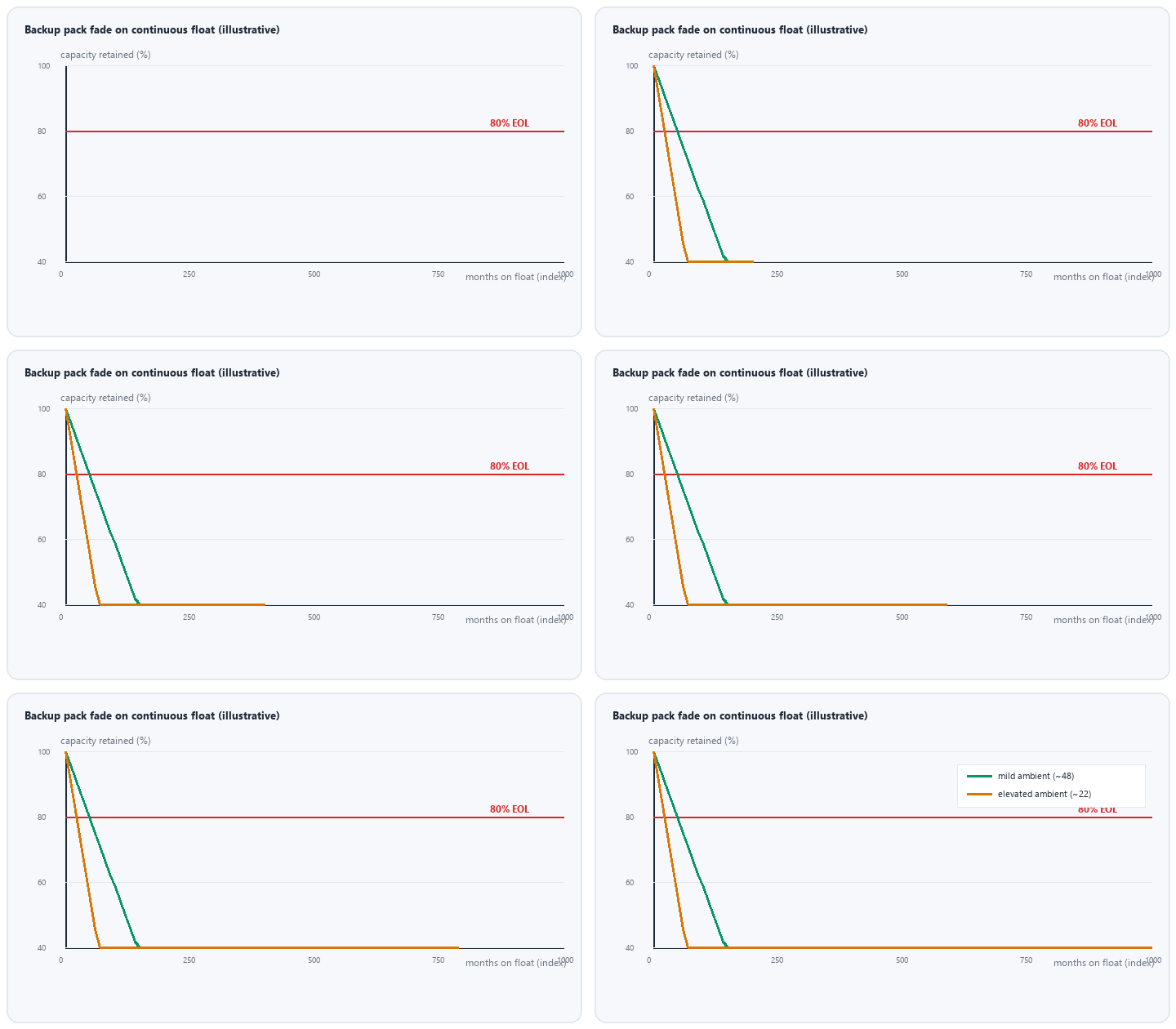
Because the pack spends its life at full charge, the decisive aging evidence is not cycle count but float endurance. A practical validation programme combines accelerated float at elevated temperature with real-time racks held at the product's declared ambient. Capacity is checked by periodic reference discharges - for example at 0, 25, 50 and 100 percent of the declared service horizon - and the time at which capacity crosses the 0.8 end-of-life line under the accelerated condition is translated back to room-temperature life using the chemistry's thermal acceleration, while the real-time rack acts as the conservative anchor. The animated chart below contrasts capacity retention in a mild controlled ambient with an elevated ceiling-void profile; it is an illustrative model of the physics, and a declaration must always cite the manufacturer's own float data. Also recorded are self-discharge after defined storage, behaviour after long idle (the pack must still deliver one bridge after months without a discharge), and the interaction between float current and cell-case temperature.
IEC 62133-1 prescribes the sealed-cell safety case: controlled charge and discharge, external short at defined resistance, forced discharge, free fall, mechanical shock and vibration, thermal abuse and, where applicable, internal-short-circuit considerations. At pack level the design adds the protection devices the application needs - thermal cut-out, current fuse, reverse-connection protection on the cartridge interface - and verifies that a single fault in the charge circuit cannot drive sustained overcharge. EMC matters because the UPS sits beside radio-linked nurse-call and telemetry hardware: IEC 60601-1-2 is the reference when the module is marketed as part of a medical system, with immunity tests proving that a burst or surge on the ward feeder neither silences an alarm nor forces a spurious transfer. Mechanical tests cover vibration in ceiling mounts and the repeated insertion cycle of a slide-out cartridge.
A backup that is never tested is a backup of unknown condition. Building-level practice, paralleling the automatic-test philosophy of IEC 62034 for emergency lighting, calls for periodic routine discharges - a short functional check at frequent intervals and a full rated-time test at a longer interval - with results logged and failures indicated locally or over the network. Marking on the module carries rated voltage and capacity, chemistry, manufacture date, rated backup time at reference load, charge specification and replacement guidance. The audit file a manufacturer should keep ready for a hospital or distributor contains: the IEC 62040 classification and test report; installation guidance cross-referenced to IEC 60364-7-710; cell datasheets to IEC 61951-2; the IEC 62133-1 safety report; UN 38.3 transport summary; float-life data with test conditions; and the recommended periodic-test schedule. That package converts a collection of components into a defensible, maintainable safety system.
Weijiang Power supports OEM ward-UPS programs with matched NiMH strings and a complete evidence trail: IEC 61951-2 cell datasheets, IEC 62133-1 safety reports, UN 38.3 summaries, float-endurance curves at multiple ambients and reference-discharge logs sized to your declared bridge time. Send us your backup-time specification, protected-load profile and target service life and we will supply both the pack and the documentation backbone your notified-body or hospital procurement file requires.


