Life-saving appliances are approved as complete systems, and a starting battery is accepted only when the lifeboat it is fitted to passes the full LSA Code and MSC.81(70) evaluation with that battery installed. This final paper maps the approval and through-life assurance route for sealed nickel-metal hydride lifeboat and rescue-boat starting and service batteries. It begins with SOLAS Chapter III and the LSA Code, which require the manual-or-dual-rechargeable-source starting system, the -15 degrees C two-minute start, the engine's protected operation and the weekly inspection and run regime, and with IMO resolution MSC.81(70), whose revised testing recommendation and standardized lifeboat/rescue-boat evaluation and test report forms define the prototype and production tests - including engine starting, operating tests, overload, launch and recovery, and the environmental exposure of the complete appliance. EU-approved appliances carry the wheel mark under the Marine Equipment Directive against the listed performance standards; position-indicating lights follow their own MED/1.2b route using MSC.81(70) clause 10.4. The paper sets out the cold-start trial that governs battery approval, the environmental and mechanical tests (temperature, vibration, shock, salt atmosphere, the free-fall or davit launch loads), the electrical safety and crew-space considerations, and the battery's own dossier - IEC 61951-2 performance, IEC 62133-1 safety and UN 38.3 transport - while maintaining the scope boundary that survivor lights, EPIRBs and survival-craft two-way VHF sets retain their mandated primary batteries. It closes with the weekly, monthly and periodic servicing and inspection regime that keeps the dual-source starting system ready, and explains how a supplier that provides complete sealed-NiMH evidence and cold-start test support helps lifeboat makers, shipyards and owners pass type approval and port-state inspections with fewer battery-related deficiencies.
Lifeboat type approval follows the LSA Code requirements and the MSC.81(70) revised recommendation on testing, recorded on the standardized lifeboat and rescue-boat evaluation and test report forms. The prototype programme includes the engine starting and operating tests, ahead and astern running, speed and towing trials, overload, self-righting or other type-specific tests, launch and recovery, and environmental exposure; production boats undergo the prescribed routine tests before delivery.
The battery is evaluated as part of the engined appliance: the dual-source architecture, the -15 C two-minute start with the actual engine and starting aids, the charging arrangement and indications, and behaviour under the launch and operating tests. The first animated figure places the battery tests within the whole lifeboat evaluation, emphasising that a cell certificate alone does not approve the installation.
The decisive battery-related trial conditions the complete lifeboat (or the engine and starting system) at -15 C and requires the engine to be started within two minutes of commencing the procedure using each independent rechargeable source in turn, with any starting aids, demonstrating that either source alone succeeds. The trial is repeated after the defined stowage/charge condition and, for robustness, at the battery end-of-service capacity used in the maintenance specification.
Instrumented trials record cranking voltage, current and time, confirming the pack holds above the starter and controller cut-out and that the switching between the two independent sources is straightforward for a crew in protective clothing. This test is where sealed NiMH's cold-current advantage is demonstrated concretely against the lead-acid baseline and where adequate derating margins are proven rather than asserted.
The complete appliance undergoes the MSC.81(70) environmental exposure - high and low temperature stowage and operation, solar/UV, salt atmosphere and corrosion, oil exposure, vibration and the shock loads of davit or free-fall launch - and the battery and its mountings must survive without leakage, displacement or loss of function. In an enclosed lifeboat the absence of free acid and minimal gas evolution from sealed NiMH is a meaningful crew-safety and ventilation benefit that is documented in the evaluation.
Electrical safety covers protection against short circuit and polarity errors, secure terminals, insulation, and the independence of the two sources under fault. Fire behaviour of battery materials and enclosure is considered within the appliance's material requirements. These tests are run on the production-representative installation, including the davit charging contacts, because corrosion at those contacts is a principal in-service failure mode.
For EU-approved equipment, lifeboats, rescue boats and their engines and components are listed in the Marine Equipment Directive and carry the wheel mark after conformity assessment (EU type examination followed by production conformity modules) against the referenced LSA/IMO standards. The battery, where it is a specified component, is documented within the appliance technical file; a replacement battery must match the approved specification or be re-evaluated.
Position-indicating lights for lifebuoys and lifejackets follow their own MED/1.2b entry, which applies MSC.81(70) clause 10.4 tests and excludes the full EN/IEC 60945 EMC suite; these appliances retain long-life primary batteries. The approval file keeps the rechargeable engine/house scope strictly separate from these primary-battery survivor appliances and from EPIRBs and survival-craft radios, avoiding an invalid substitution claim.

The cells and packs are supported by IEC 61951-2 (sealed NiMH performance: capacity, internal resistance, charge retention, endurance) and IEC 62133-1 (safety under intended use and foreseeable misuse), with UN 38.3 for transport; sealed non-lithium NiMH ships comparatively simply as spares to shipyards and vessels. The lifeboat dossier adds the cold-cranking and -15 C two-minute results, vibration/shock and salt-atmosphere exposure, charge-retention over the stowage interval, compatibility evidence for the alternator and davit charger profile, and the dual-source independence and switching tests.
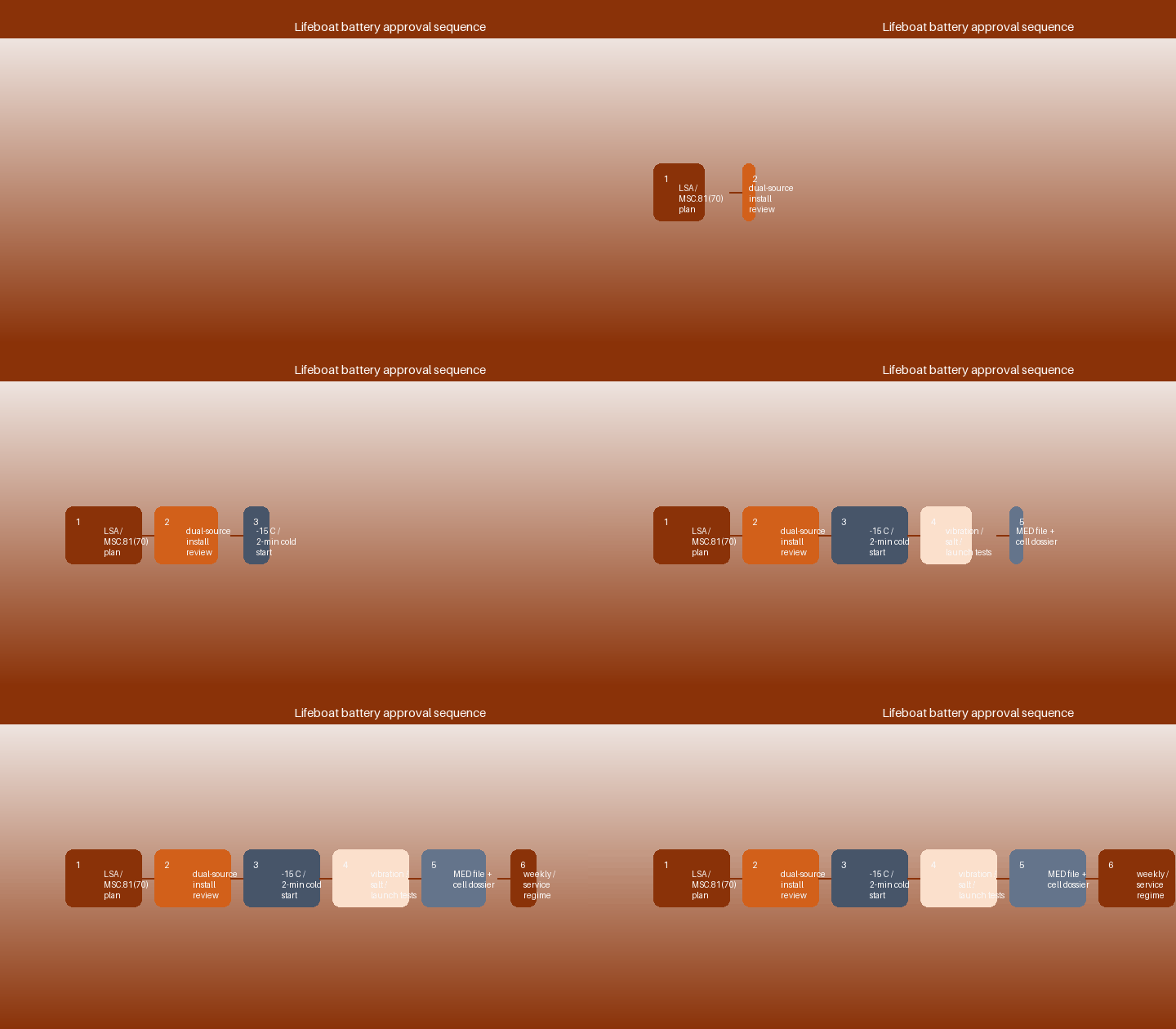
The second animated figure sequences the dossier from cell certificates to the installed-boat cold-start trial. Lot traceability and construction control ensure that production and spare packs match the type-tested design, and the charger profile is fixed and documented to prevent the overcharge-related degradation that an unspecified charger could cause in service.
SOLAS III/20 and the LSA Code require weekly checks and an engine run of at least three minutes (observing cooling-water and exhaust constraints), monthly inspections and periodic thorough servicing and operational tests by certified personnel, plus the five-year overhaul regime. Battery items - charge state, terminal and charging-contact corrosion, dual-source availability and the cold-start margin - are central to these checks and to port-state and classification inspections, where weak lifeboat batteries are a recurrent deficiency.
Sealed, low-self-discharge NiMH dual-source packs reduce the electrolyte and corrosion workload and make the weekly run and periodic load tests more likely to pass, while supervision/indications show source health. Delivered with complete IEC 61951-2, IEC 62133-1 and UN 38.3 evidence, instrumented cold-start data and clear MED/LSA scope documentation, such packs give lifeboat makers and shipowners a more reliable, lower-maintenance way to meet the unforgiving requirement that, at -15 C in an emergency, either of two independent sources starts the engine within two minutes.
Weijiang Power designs and manufactures sealed nickel-metal hydride cells and matched industrial packs for remote, off-grid and safety-related equipment, and supports OEM partners with IEC 61951-2 performance files, IEC 62133-1 safety evidence, pulse-load characterisation, wide-temperature testing and charger/pack co-validation. Tell us your duty cycle, peak current, temperature envelope, autonomy target and the standards your product must meet, and our engineers will specify a cell-and-pack combination that protects runtime, reliability and service life. Review the range on the products page.


